Verifiable Credentials. The future of digital identity?
Identity is a fundamental to every digital interaction, but passwords are no longer the only way to prove who we are online. Verifiable Credentials transform digital identity by giving users greater control over their data and enabling secure, trustworthy verification. This article introduces the key concepts behind Verifiable Credentials, decentralised identity, digital wallets and the cryptographic mechanism that enable them.



Verifiable Credentials. The future of digital identity?
In today’s world, digital identity is a part of our day-to-day life. Proving who we are and what we have has become essential. Traditional systems very often rely on a centralized authority (e.g., Microsoft, Google, Facebook). These authorities, or Identity Providers, have almost complete control over how our digital identity is managed, verified, and presented to online services. This makes it quite difficult for us to know how our data is used, when it is shared, and who has access to it. These problems have fuelled the search for more reliable and privacy-oriented ways to build trust online.
Verifiable Credentials (VCs) are emerging as a solution to this challenge. Built on around decentralized identity principles, they let users to take full control of their digital identity. Users can decide where they store their data and what information they share. By leveraging public key cryptography, the whole process of issuing, storing, and presenting these verifiable credentials is secure.
As governments, enterprises, and technology providers explore digital identity frameworks, verifiable credentials are quickly moving from concept to real-world adoption. Understanding how they work can offer a glimpse into the future of digital identity management.
Connect with the author on LinkedIn

Centralized identity management system
To fully understand decentralized identity (and with that, verifiable credentials), we first need to look at the traditional identity management system flow:
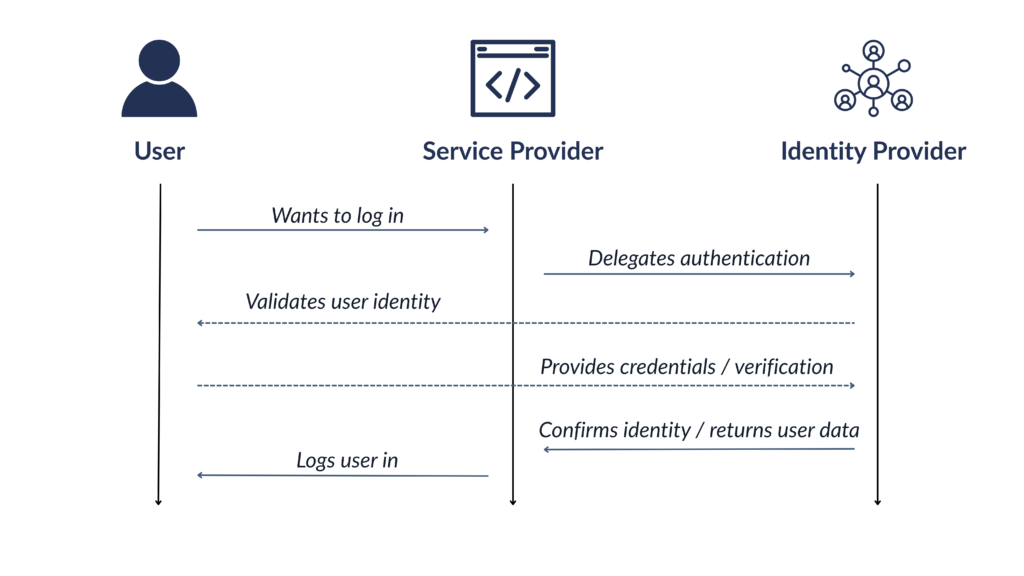
This flow starts when a user wants to log in to a Service Provider (SP). Then, to retrieve information about the user’s identity, the Service Provider delegates the authentication process to the Identity Provider (IdP). The IdP verifies the user’s identity by requesting their credentials. If the credentials are valid, the IdP confirms the user’s identity to the SP.
In this type of system, the IdP acts as a trusted intermediary between users and services. It controls user authentication and manages identity attributes that are shared with relying parties. As a result, users must place significant trust in the IdP and cannot always verify how their personal data is handled behind closed doors.
This is solved in a decentralized identity management system.
Decentralized identity management system
Let’s look at the most basic decentralized identity management system flow:
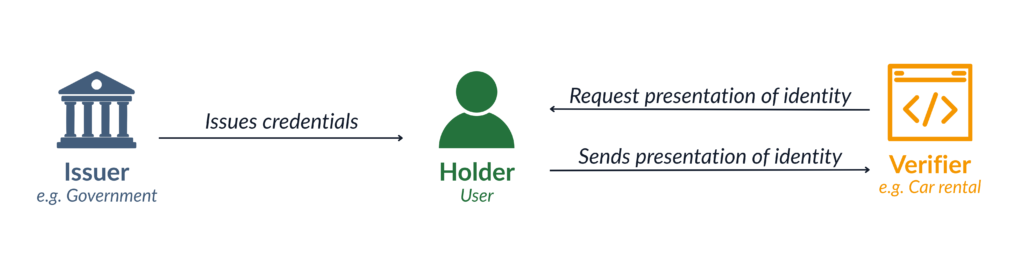
To make things easier to understand, let’s compare this flow to a situation when we want to rent a car. To do so, we (the holder) must present to the car rental company (the verifier) some document (a credential) that we possess, which will confirm our identity and qualifications, e.g., a driving license. This credential must have some sort of marks of authenticity to ensure it was not tampered with and that it was issued by a trusted issuer (e.g., the Government). In the case of a driving license, it may be a watermark. For a digital identity, it is a cryptographically verifiable signature. The mark of authenticity will allow this credential to be verified. After sending this verifiable credential to the verifier, the holder’s identity is confirmed.
To summarize, there are three main entities:
- The issuer – an entity that can assert claims about one or more subjects and create a verifiable credential from these claims. Issuers include corporations, non-profit organizations, trade associations, governments, and individuals.
- The holder – an entity that possesses one or more verifiable credentials and can present them in a verifiable presentation. They are often, but not always, the subject of the verifiable credentials that they are holding (e.g., a person can possess a vaccination record book of their pet). Example holders include students, employees, and customers.
- The verifier – an entity that performs verification of a received verifiable credential. Example verifiers include employers, security personnel, and websites.
It looks simple, doesn’t it? Let’s take a deeper dive into the matter and complicate things a little bit. We will come back to our example later and piece everything together.
Digital wallets and Verifiable Credentials
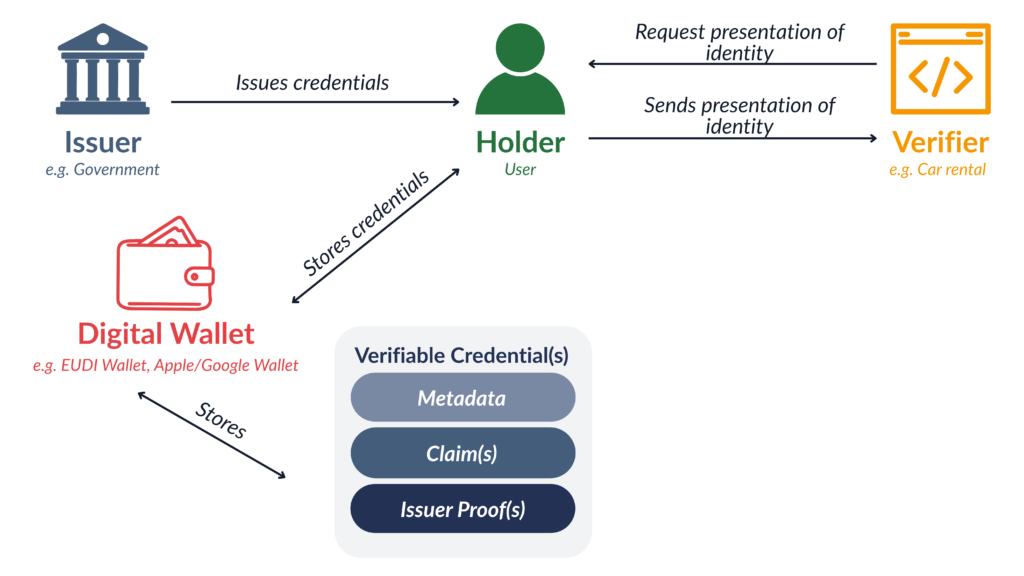
We now know that the holder owns and stores claims about the subject (which may but does not have to be the holder) in verifiable credentials. But where do they store them? The answer is very simple: they are stored in a similar way that we may store our ID cards or driving licenses – in a wallet. Well, in this case, a digital wallet. A digital wallet (or a credential repository) is software that stores and protects access to the holder’s verifiable credentials. An example of it may be an Apple Wallet or Google Wallet, or even an officially regulated solution, such as the European Digital Identity Wallet (EUDI Wallet). Modern digital wallets do more than simply store credentials. They also manage cryptographic keys, create verifiable presentations, and allow users to selectively disclose information to verifiers. You might say that they serve as the primary interface through which users interact with decentralized identity systems.
Today, three credential formats stand out within the verifiable credentials ecosystem:
- W3C Verifiable Credentials,
- SD-JWT VC,
- ISO mdoc (ISO/IEC 18013-5).
Support for these standards varies across digital wallets. For example, Apple Wallet identity credentials are currently based on the ISO mdoc standard.
In this article, I will focus on the W3C Verifiable Credentials Data Model, which provides the foundational model for many VC implementations.
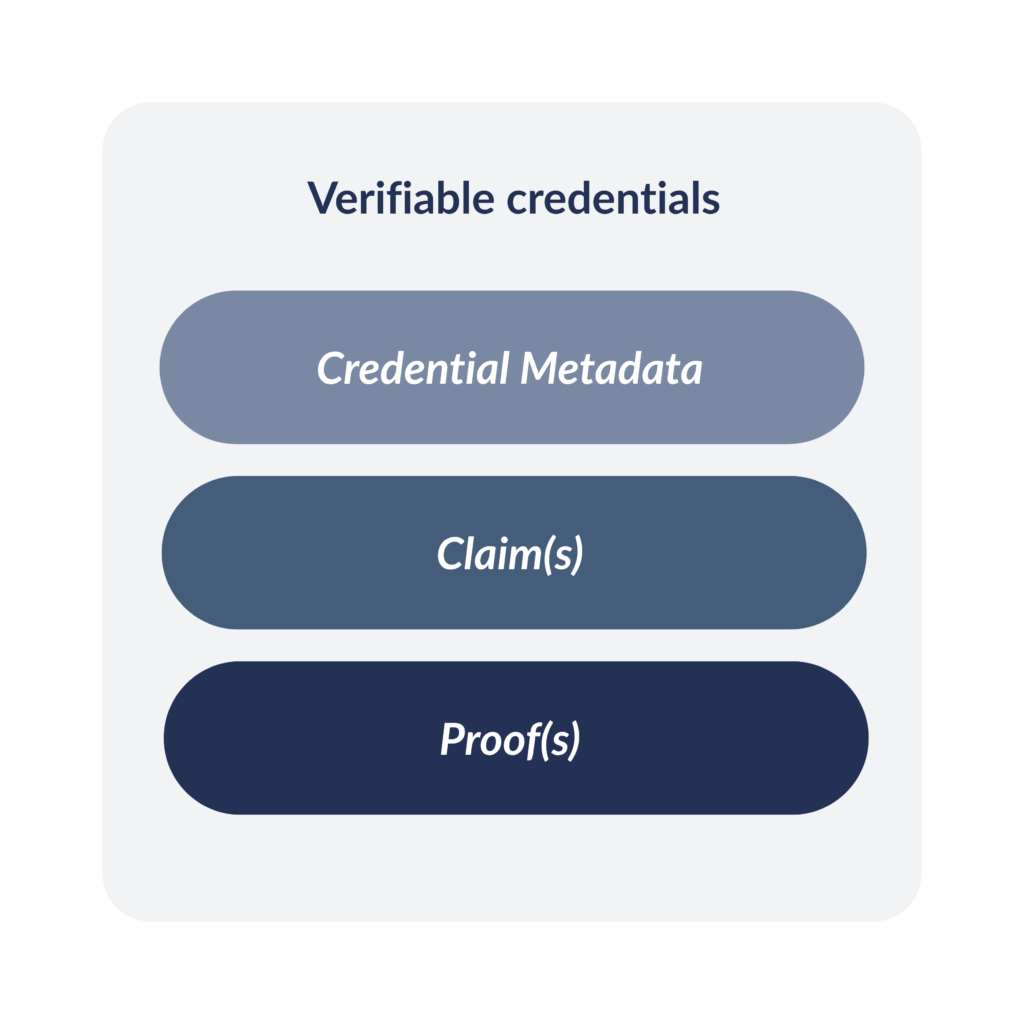
Let’s take a look at what a verifiable credential consists of. According to the W3C VC model, it has three basic components:
Metadata
The first one is credential metadata. It contains, among other things, information about its issuer, credential validity, and verification material (e.g., a cryptographic key). By analogy to a physical driver’s license, this would be the data describing the document itself, such as its identifier, issuing authority, and validity period.
Claim(s)
The second component is a claim about the subject. It may be, for example, your given name or a date of birth the same as in a physical document. Often, that data is considered Personally Identifiable Information (PII), meaning any information that can be used to identify a specific individual. Also, there may be more than one claim in a verifiable credential.
Proof(s)
The last component of a verifiable credential is a proof. It contains cryptographic evidence that the credential was issued by the issuer and has not been tampered with. In many implementations, the proof includes a digital signature created using the issuer’s private key and a standardized form of the credential’s contents (e.g., a hash), along with metadata describing how the signature can be verified. In a physical driver’s license, such security features include holograms, watermarks, and official seals.
Here is an example of a simple credential:
{
  "@context": [
    "https://www.w3.org/ns/credentials/v2",
    "https://www.w3.org/ns/credentials/examples/v2"
  ],
  "id": "https://dmv.example.gov/credentials/987654321",
  "type": [
    "VerifiableCredential",
    "DrivingLicenseCredential"
  ],
  "issuer": "did:example:dmv-poland",
  "validFrom": "2025-01-01T00:00:00Z",
  "validUntil": "2035-01-01T00:00:00Z",
  "credentialSubject": {
    "id": "did:example:abcdef1234567",
    "givenName": "Jan",
    "familyName": "Kowalski",
    "dateOfBirth": "1995-05-15",
    "drivingPrivileges": [
      {
        "category": "B",
        "validFrom": "2025-01-01",
        "validUntil": "2035-01-01"
      }
    ],
    "issuingCountry": "PL"
  },
  "proof": {
    "type": "DataIntegrityProof",
    "cryptosuite": "eddsa-rdfc-2022",
    "created": "2025-01-01T00:00:00Z",
    "verificationMethod": "https://dmv.example.gov/issuers/1#key-1",
    "proofPurpose": "assertionMethod",
    "proofValue": "z58DAdFfa9SkqZMVPxAQp...jQCrfFPP2oumHKtz"
  }
}
Inside, we can clearly see its metadata: sections id, type, issuer, validFrom, and validUntil. The issuer section uses a new type of identifier called a decentralized identifier (DID), which will be covered in a later section. Next, we have the credentialSubject section that contains claims. The last section is the proof.
Let’s update our diagram:
When the verifier wants to get VCs from the holder, they can request a special type of presentation.
Verifiable presentation
Verifiable Presentation (VP) is a tamperproof package created by the holder of one or more verifiable credentials to present selected claims to a verifier in a secure, confidential, and context-specific way. Instead of presenting an entire credential, the holder can share only the information required for a given transaction, while proving possession of said credential through a cryptographic signature. This reduces unnecessary data exposure. It is not just a wrapper around a VC, but a demonstration that a legitimate holder is participating in the verification process. VP also makes it harder for a malicious actor to reuse a copy of an obtained credential.
Like VCs, verifiable presentations have three components:
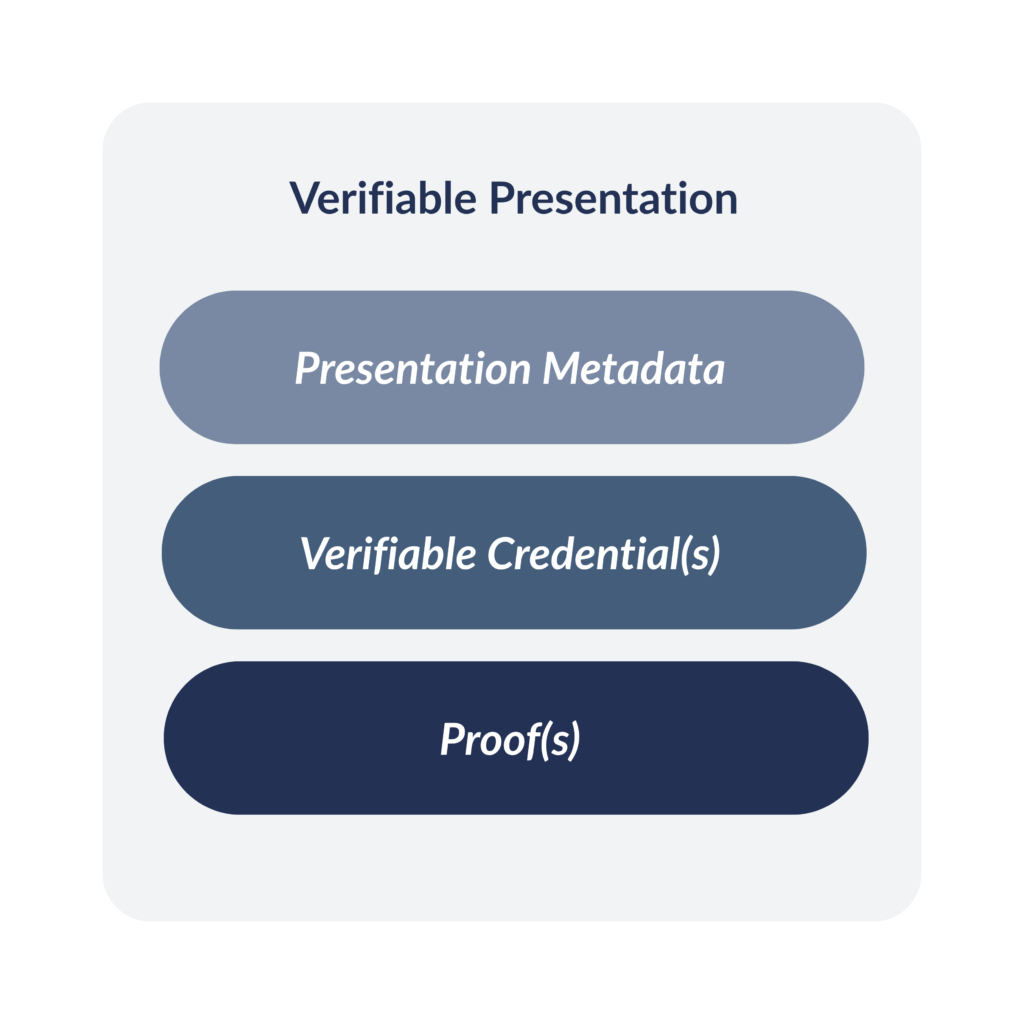
Metadata
The first component is the presentation metadata. It contains information about the holder, e.g., their identifier and signature (proof).
Verifiable Credential(s)
The second part is verifiable credentials.
Proof(s)
The third component is, again, a proof. This one is created by the holder and is used to verify the authenticity and integrity of the presentation’s contents and enables protection against replay-attacks. It allows the verifier to trust the presentation without relying on a centralized authority.
Look at an example VP:
{
  "@context": [
    "https://www.w3.org/ns/credentials/v2",
    "https://www.w3.org/ns/credentials/examples/v2"
  ],
  "type": ["VerifiablePresentation", "ExamplePresentation"],
  "id": "urn:uuid:313801ba-24b7-11ee-be02-ff560265cf9b",
  "holder": "did:example:12345678",
  "verifiableCredential": [{
    "@context": [
      "https://www.w3.org/ns/credentials/v2",
      "https://www.w3.org/ns/credentials/examples/v2"
    ],
    "type": ["VerifiableCredential", "ExampleAssertCredential"],
    "issuer": "did:example:12345678",
    "credentialSubject": {
      "id": "urn:uuid:313801ba-24b7-11ee-be02-ff560265cf9b",
      "assertion": "This VP is submitted by the subject as evidence of a legal right to drive"
    },
    "proof": {  }
  }],
  "proof": {  }
}
Source: https://www.w3.org/TR/vc-data-model/#example-a-verifiable-presentation-secured-with-an-embedded-data-integrity-proof-with-a-self-asserted-verifiable-credential-about-the-verifiable-presentation
Its structure is very similar to that of a verifiable credential. Sections type, id, and holder are the metadata, with holder using, once again, a new format of a decentralized identifier. The verifiableCredential contains exactly that. As you can see, it has the same format as the example above. Lastly, we have the proof section.
Now let me add VP to our diagram:
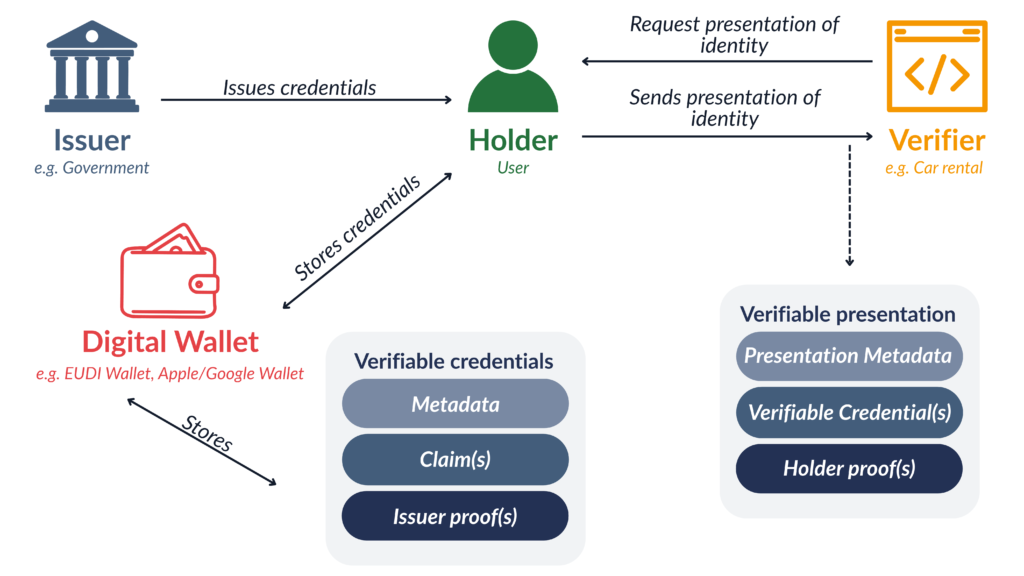
The whole concept of verifiable credentials has much more to offer. Let me give you a brief overview of the Zero-Knowledge Proof.
Zero-Knowledge Proof and Selective Disclosure
The Verifiable credential ecosystem, designed around user independence, security, and privacy, offers advanced mechanisms that give users precise control over what information they disclose. The two most important privacy-enhancing features are Zero-Knowledge Proof (ZKP) and Selective Disclosure.
Zero-Knowledge Proof allows the holder to prove a specific statement without revealing additional information. This means that the verifier learns only that the claim is true and nothing else. For example, instead of disclosing a full date of birth, the holder can generate a proof that confirms compliance with the requirement, such as “I am over 18”. With such proof, the verifier receives confirmation of the condition and does not gain access to the personal data. This minimizes unnecessary exposure of personal information.
Selective Disclosure complements ZKP. It lets the holder choose a precise piece of information to share with the verifier while keeping all remaining attributes hidden. The holder does not need to show their full ID and reveal their given and family name, date of birth, or address. They can simply choose, for example, to only show their first name.
These security mechanisms are particularly valuable for online age verification, which is becoming increasingly common across social media platforms and gaming services. Many of these services are introducing measures to prevent minors from accessing content that is age restricted. In numerous cases, age verification relies on traditional, centralized IdPs, which offer users limited visibility into what information is being shared. Such IdP may claim that they only share the user’s age, and the user must trust that only the minimum information is disclosed. With Verifiable Credentials and Zero-Knowledge Proof or Selective Disclosure, the user can be sure what claims are being shared.
Now, we can cover the previously mentioned decentralized identifiers.
Connect with the author on LinkedIn
Decentralized Identifiers
Decentralized identifiers (DIDs) are a new type of globally unique identifiers that are used to identify all entities within the decentralized identity management system. They are designed in a way that allows individuals and organizations to generate their own DIDs. This means that DIDs do not require a centralized registration authority. One can prove control over a DID using cryptographic proofs like digital signatures.
Their structure is very simple. It is a URI in the following format:
did:[method]:[unique_identifier] It always starts with a did URI scheme, just like a web address with https.
Then, it is followed by a DID method that defines how software should interact with a DID. This includes information about how it was created as well as how it should be resolved, updated, and deactivated. There are many DID methods. Here you can find a list of all of them currently in development.
The last part of a DID is its unique identifier. The format of this identifier depends on the DID method used. For example, a DID created using the web method would look like this:
did:web:securing.pl However, a DID created using the key method would look completely different:
did:key:z6MkhaXgBZDvotDkL5257faiztiGiC2QtKLGpbnnEGta2doK As you can see, DIDs are very flexible. Depending on your needs, you may want to use different DID methods.
If you want a full decentralization, you may want to use the key method. It uses a public key as a unique identifier. It is very simple as it does not need any external dependencies. Of course, there are some major drawbacks, like lack of key rotation (new key equals new DID) and lack of recovery in case of a lost DID. Nevertheless, this method works great in digital wallets.
If, on the other hand, some centralization does not bother you, the web DID method could be your choice. It trades some of decentralization for operational simplicity by using DNS, TLS certificates, and web servers. Here, the trust comes from control of the domain and its TLS certificate. It is rather easy to implement and operate and can be used, for example, in a corporate environment for credential issuance.
To enable DID resolution during a verifiable presentation, DIDs are typically recorded on an underlying system or network. This system is known as a Verifiable Data Registry or a trust system.
Verifiable Data Registry
A Verifiable Data Registry (VDR) is a role that a system can perform by providing a trusted source for information needed to verify digital credentials. Depending on its implementation, it can enable verification without relying on a central authority. Typically, it allows participants to register DIDs, publish their public keys, store verifiable credential schemas and metadata and publish revocation information for VCs. Think about it as a place that stores all the information needed to verify that credentials are authentic. An example of a trust system may be a database, decentralized file system, or a blockchain.
In our scheme, it takes place at the bottom:
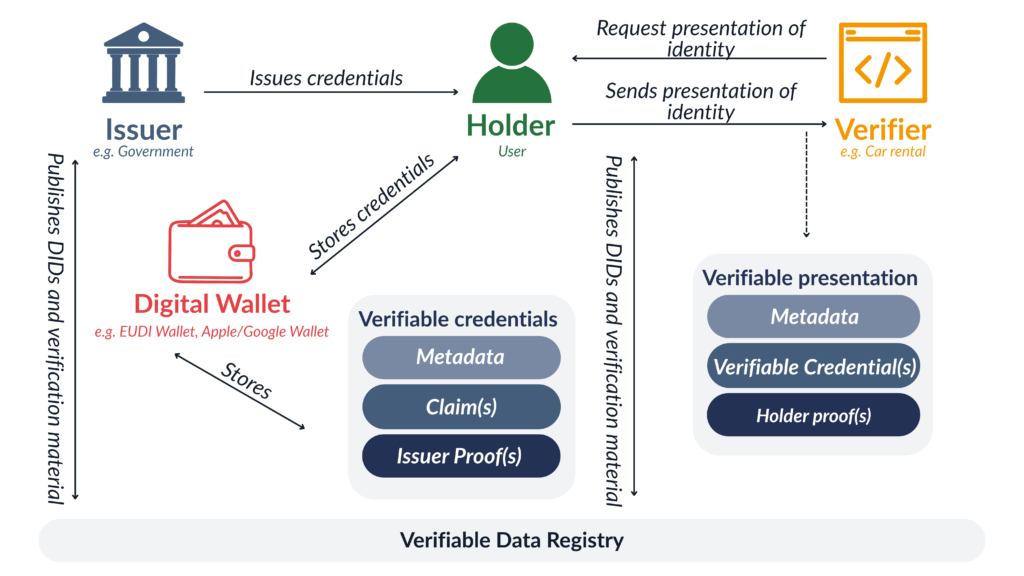
In the process of verification, the verifier needs to fetch the verification information from the VDR, which is possible using DID documents and DID resolvers.
DID documents and DID resolvers
DIDs are used to identify entities such as issuers, holders, and verifiers. When a verifier receives a verifiable presentation, they typically extract DIDs of the issuer and the holder. Then, these identifiers are sent to a DID resolver, a software and/or hardware component that performs resolution of a DID by taking a DID as an input and returning a DID document together with relevant metadata as an output. The DID document contains information such as verification methods (e.g., public keys) and service endpoints associated with the DID. Using the verification methods from the resolved DID document, the verifier can cryptographically validate the signatures or proofs contained in the presentation and its credentials.
DID resolvers are not inherently centralized or decentralized. Their architecture depends on the DID method used and on how the resolver is deployed. It may be operated locally by the verifier or remotely as a service, such as a universal resolver.
A DID document may look like this:
{
    "@context": [
      "https://www.w3.org/ns/did/v1",
      "https://w3id.org/security/suites/ed25519-2020/v1"
    ],
    "id": "did:example:123",
    "authentication": [
      {
        "id": "did:example:123#z6MkecaLyHuYWkayBDLw5ihndj3T1m6zKTGqau3A51G7RBf3",
        "type": "Ed25519VerificationKey2020", // external (property value)
        "controller": "did:example:123",
        "publicKeyMultibase": "zAKJP3f7BD6W4iWEQ9jwndVTCBq8ua2Utt8EEjJ6Vxsf"
      }
    ],
    "capabilityInvocation": [
      {
        "id": "did:example:123#z6MkhdmzFu659ZJ4XKj31vtEDmjvsi5yDZG5L7Caz63oP39k",
        "type": "Ed25519VerificationKey2020", // external (property value)
        "controller": "did:example:123",
        "publicKeyMultibase": "z4BWwfeqdp1obQptLLMvPNgBw48p7og1ie6Hf9p5nTpNN"
      }
    ],
    "capabilityDelegation": [
      {
        "id": "did:example:123#z6Mkw94ByR26zMSkNdCUi6FNRsWnc2DFEeDXyBGJ5KTzSWyi",
        "type": "Ed25519VerificationKey2020", // external (property value)
        "controller": "did:example:123",
        "publicKeyMultibase": "zHgo9PAmfeoxHG8Mn2XHXamxnnSwPpkyBHAMNF3VyXJCL"
      }
    ],
    "assertionMethod": [
      {
        "id": "did:example:123#z6MkiukuAuQAE8ozxvmahnQGzApvtW7KT5XXKfojjwbdEomY",
        "type": "Ed25519VerificationKey2020", // external (property value)
        "controller": "did:example:123",
        "publicKeyMultibase": "z5TVraf9itbKXrRvt2DSS95Gw4vqU3CHAdetoufdcKazA"
      }
    ]
}
Source: https://www.w3.org/TR/did-1.0/#example-did-document-with-1-verification-method-type
The first section of a DID document is the id, which identifies the DID subject described by the document. Next is the authentication section. It contains verification methods (usually public keys) that can be used for proving control of the subject DID. The capabilityInvocation section contains public keys authorized to perform privileged actions on behalf of the DID. The capabilityDelegation section contains public keys authorized to delegate such privileges to other parties. Finally, the assertionMethod section contains keys used to make signed assertions, such as issuing verifiable credentials.
Piecing it together
Adding all the parts of the decentralized identity management system described above, here is the updated diagram:
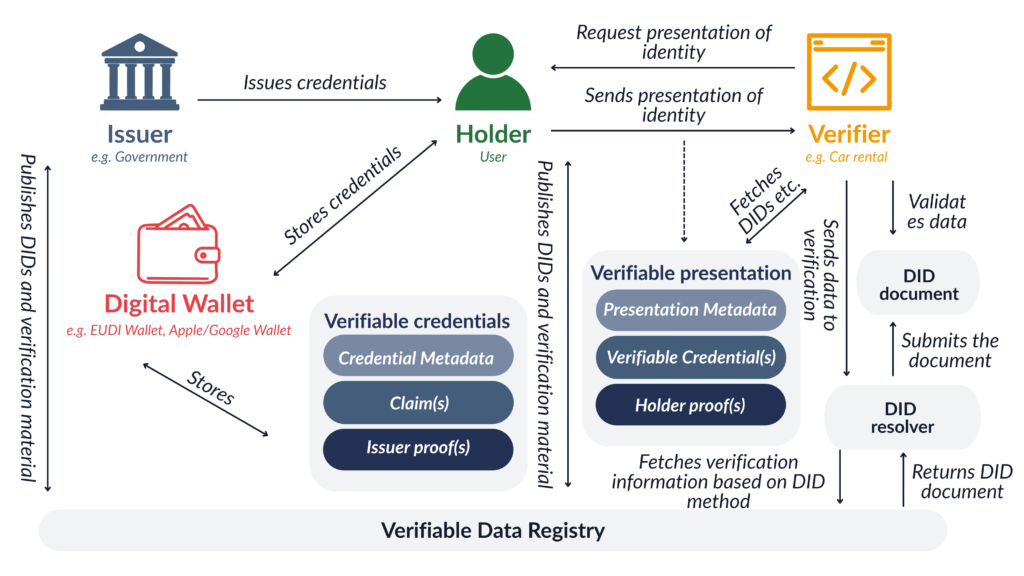
As you can see:
- The verifiable data registry stores and makes available verification material required for verification, such as DID documents, public keys, credential status information, and other trust metadata.
- The issuer issues verifiable credentials to the holder, who usually stores them in a digital wallet.
- Each verifiable credential contains a cryptographic proof, most commonly a digital signature from the issuer.
- Later, a verifier requests a verifiable presentation from the holder. The presentation may contain one or more credentials and includes a holder proof that demonstrates control of the associated identifier or cryptographic key.
- Upon receiving the presentation, the verifier extracts the relevant identifiers, often DIDs, and resolves them, typically through a DID resolver.
- The DID resolver retrieves the necessary verification data according to the applicable DID method and resolves each DID to its corresponding DID document.
- The verifier can then validate the cryptographic proofs in the credentials and presentation and check additional requirements such as credential status and expiration date.
The Path Toward Self-Sovereign Identity
Verifiable Credentials represent a significant shift in the way digital identity can be managed and verified. Centralized identity providers are no longer required to mediate every interaction. Instead, individuals and organizations can exchange trusted information directly with greater control over privacy and data sharing. Using public key cryptography, digital wallets, trust registries, and decentralized identifiers, verifiable credentials enable secure, tamper-proof interactions. Features like Zero-Knowledge Proof and Selective Disclosure further enhance privacy and security by allowing users to share only the information that is needed.
The constantly evolving standard of decentralized identity management continues to grow. It is being adapted by the European Union in the EUDI Wallet, which indicates that this technology is becoming increasingly important and is moving from theory into a large-scale real-world implementation. It will play a big role in the future of identity management. As verifiable credentials become more widely available, they are expected to play an important role in application authentication, potentially reducing reliance on traditional passwords and enabling users to securely prove claims about themselves.
Understanding how decentralized identity and verifiable credentials work is essential for understanding the future of digital identity management.